
CAYRA KNOWLEDGE / HIV+ PATIENT GUIDES
Penile Implant Surgery in Turkey for HIV+ Men: Safety, Protocols and Results
Penile implant surgery for HIV patients in Turkey may be considered after confidential urology and medical assessment. HIV status is one element of infection and healing risk; erectile-dysfunction diagnosis, prior treatments, viral control, diabetes, smoking, urinary infection and device or revision factors all matter.
Updated 20 August 2026 · Evidence-led patient information · Individual eligibility requires specialist review
PRIVATE, CASE-BY-CASE REVIEW
HIV status alone does not answer whether a procedure is appropriate. The treating specialist reviews the procedure, current health, HIV control, medicines and recovery plan together.

QUICK ANSWER
A penile prosthesis is usually considered for erectile dysfunction that has not responded to, is unsuitable for, or is not tolerated with less invasive treatment. Well-controlled HIV does not automatically exclude implantation, but HIV-specific penile-prosthesis evidence is limited. The urologist should assess current HIV control and active infection alongside diabetes, smoking, previous prosthesis or pelvic surgery, urinary health, skin conditions and the patient’s ability to operate and care for the device.
What the medical team needs to review
| Review area | Why it matters | What may be requested |
|---|---|---|
| ED diagnosis and goals | An implant treats rigidity, not libido, orgasm, ejaculation or every relationship concern. | Medical and sexual history, prior tablets/injections/vacuum therapy, testosterone and metabolic tests when indicated. |
| HIV and infection review | Implanted hardware makes prevention and early recognition of infection critical. | Recent viral load/CD4 information when requested, ART list, OI history, skin/urinary symptoms and HIV clinician input. |
| Device and surgical history | Primary, revision, Peyronie's and post-priapism cases can require different planning. | Previous pelvic/urologic surgery, radiation, priapism, curvature, existing implant records and hand-dexterity assessment. |
| Modifiable risks | Diabetes, smoking and active infection can influence wound and device risk. | HbA1c/glucose assessment when relevant, urine testing per protocol, smoking plan, allergies and full medicine list. |
When is a penile prosthesis considered?
Guidelines from the American Urological Association and European Association of Urology place penile prosthesis within a shared decision pathway for erectile dysfunction. Depending on cause and patient preference, other options can include risk-factor treatment, counseling, PDE5 inhibitor tablets, vacuum erection devices or intracavernosal/intraurethral therapy. Some men choose an implant after these fail or are unsuitable; selected complex Peyronie’s disease, post-prostatectomy, fibrosis or priapism cases may also be considered.
A prosthesis creates an erection mechanically. It does not ordinarily increase natural penile length, restore sensation lost from nerve disease, raise libido or guarantee orgasm or partner satisfaction. Preoperative measurement and honest discussion of perceived length are important because dissatisfaction can occur even when the device functions.
HIV can coexist with vascular, metabolic, hormonal, neurological, medication-related and psychological contributors to ED. The urologist should avoid attributing every symptom to HIV or ART. Cardiovascular risk assessment matters because ED can be associated with vascular disease.
Inflatable and malleable penile implants
Three-piece inflatable devices use paired cylinders, a scrotal pump and an abdominal/pelvic reservoir. They can provide greater flaccidity when deflated but involve more components and require manual pump use. Two-piece inflatable devices avoid a separate reservoir in selected cases. Malleable rods are manually positioned and have fewer mechanical components but remain firm and can be less discreet.
The “best” implant depends on anatomy, prior pelvic surgery, scarring, hand strength, lifestyle, concealment preferences, surgeon experience, device availability and funding. Coatings and infection-control features vary by manufacturer and market. A brand comparison must use the exact current model, warranty terms and regulatory availability—never a generic “lifetime” promise.
Cayra publishes a live guide to penile implant types and brands. It is educational; the chosen device must appear in the urologist’s written plan after examination.
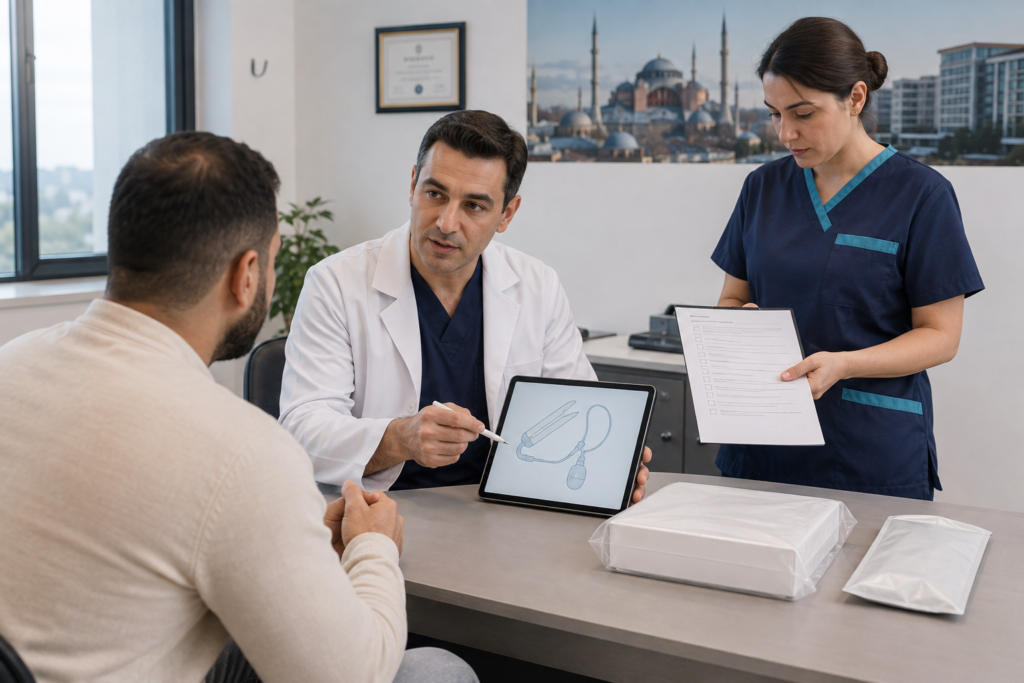
HIV, prosthesis infection and risk optimization
Prosthesis infection is a serious complication because it may require device removal, washout and salvage or delayed reimplantation. Reviews identify multiple patient, device and operative factors. HIV-specific evidence is sparse and sometimes extrapolated from other implanted surgeries; a review of complex prosthesis infection prevention notes that well-controlled HIV may not carry the same risk as uncontrolled immunosuppression, but the certainty is limited.
The team should review current viral load, immune and opportunistic-infection history and ART adherence. Active urinary, genital or skin infection needs assessment. Diabetes control and smoking should be optimized. Revision surgery, previous infection, fibrosis and complex reconstruction can raise difficulty and risk compared with first-time implantation.
Hospital protocols may include urine testing, skin preparation, perioperative antibiotics, coated devices, “no-touch” handling and other sterile measures. Patients should not self-treat with extra antibiotics. The surgeon must account for allergies, local microbiology and individual risk.
ART, anaesthesia, antibiotics and pain medicines
ART should generally continue, with exact drug names available to the anaesthesia and urology teams. Some antiretrovirals—especially boosted regimens—can interact with sedatives, opioids, corticosteroids and other perioperative medicines. Kidney or liver dysfunction can further alter dosing. The prescriber or pharmacist should use a reliable interaction resource rather than assuming the regimen is compatible.
Discuss anticoagulants, antiplatelet medicines, diabetes medicines, erectile-dysfunction drugs, supplements and recreational substances openly. Do not stop blood thinners or ART based on an internet checklist. The relevant prescribers and surgeon should balance bleeding, thrombosis and treatment-continuity risks.
Recovery, device activation, results and travel
Swelling, bruising and discomfort occur after implantation, but the expected course and dressings vary. The surgeon decides when showering, work, exercise, driving, device cycling and sexual activity can begin. Inflatable devices are usually activated after initial healing, with training to inflate and deflate; the timing is individualized.
Report fever, worsening redness, drainage, skin breakdown, severe increasing pain, difficulty urinating, device exposure, inability to operate the device after training or other concerns promptly. Infection can present early or later. Mechanical problems may require revision; no device lasts forever, and reoperation risk belongs in consent.
For international treatment, remain long enough for the surgeon’s required early reviews and travel clearance. Obtain the operation report, device manufacturer/model/serial or patient card, antibiotic and pain plan, activation date, wound instructions, emergency contacts and warranty process. Identify a urologist at home willing to review the implant.
Use the Cayra contact page for a confidential preliminary review. The urologist and facility must confirm HIV-positive case acceptance, device availability, technique and dates.

Frequently asked questions
Can an HIV-positive man receive a penile implant?
Potentially, yes. HIV is not an automatic exclusion, but evidence specific to penile prostheses is limited. Urology and HIV teams should assess viral control, infection history, medicines, diabetes, smoking, urinary health and surgical complexity.
Which penile implant is best for a man with HIV?
There is no HIV-specific best device. Inflatable and malleable options have different handling, concealment and mechanical trade-offs. Anatomy, prior surgery, dexterity, preference, surgeon experience and current device availability guide choice.
Does a penile implant increase length?
It is intended to create reliable rigidity, not enlarge the penis. Perceived length may differ after surgery, so preoperative measurement and expectation counseling are essential.
Is infection guaranteed to be higher because of HIV?
No universal conclusion is justified. HIV-specific evidence is limited and control matters. The team assesses viral status and conventional risks such as diabetes, smoking, active infection, revision surgery and previous implant infection.
Should ART stop before penile implant surgery?
Do not stop ART yourself. Give the exact regimen to the urology, anaesthesia and pharmacy teams so it can continue whenever possible with interactions and timing checked.
What records should I take home after surgery?
Obtain the operation report, device details and patient card, medicine list, wound and activation instructions, emergency contacts, warranty information and follow-up schedule.
Related Cayra treatment guides
Continue your research with these verified live Cayra pages:
Medical sources and further reading
This guide is educational and does not replace advice from your HIV clinician or treating specialist.
- American Urological Association — Erectile Dysfunction Guideline
- European Association of Urology — Management of Erectile Dysfunction
- Hebert and Kohler — Penile Prosthesis Infection: Myths and Realities
- Baird et al. — Penile implant infection factors: narrative review
- NYSDOH AIDS Institute — Perioperative Care in Adults With HIV
Request a private urology and medication review
Share your ED history, previous treatments, operations, medicines and requested HIV information through a confidential pathway. A named urologist must confirm candidacy and the device plan.
No treatment, price, date or eligibility is confirmed until the appropriate specialist and facility have reviewed the case.
