
Cayra Knowledge / Gynecomastia
How Do Surgeons Decide Between Liposuction and Gland Excision? The Pinch Test Explained
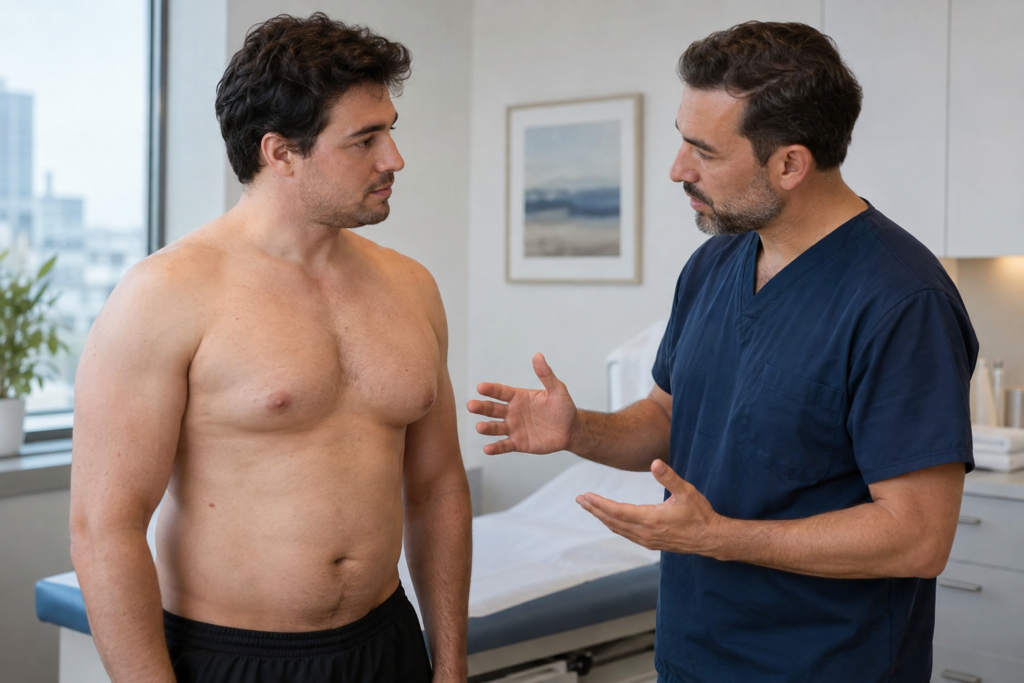
Liposuction removes fat, while excision removes tissue directly and may be needed for firm glandular tissue or excess skin. Surgeons often use both. A pinch assessment can contribute to the examination, but no home pinch test reliably diagnoses gynecomastia or determines the right operation.
Cayra Clinic · 3 min read · Patient guide
What the examination is trying to establish
An enlarged chest can involve fat, glandular breast tissue, loose skin or a combination. The surgeon also considers the position of the nipple, the shape of the chest wall and differences between the two sides. A plan based only on the apparent size misses these details.
The ASPS procedure guide describes liposuction for a predominantly fatty component and excision for glandular tissue or skin when required. Cayra's gynecomastia treatment page introduces the available approaches.
What people mean by the pinch test
During examination, the clinician may gently feel and compare the tissues around the areola and across the chest. This can help assess thickness, consistency and skin. A firmer area beneath the areola may suggest glandular tissue, but touch alone does not establish every cause of a lump.
Avoid repeatedly squeezing the chest to prove a diagnosis. Tenderness after repeated manipulation can make the picture less clear. Tell the clinician about onset, growth, pain, discharge and medicines instead of arriving with a conclusion based on an online test.
How the findings affect the plan
| Finding | Possible approach | Why it matters |
|---|---|---|
| Predominantly excess fat with suitable skin | Liposuction may be considered | Direct gland removal may not be the main need |
| Firm gland beneath the areola | Excision may be needed | Suction alone may leave the prominence |
| Fat and gland together | Combined treatment | Both components influence contour |
| Significant loose skin | Skin removal or another tailored approach | Removing volume alone may not tighten the skin enough |
This is a decision framework, not a diagnosis. Some patients need medical investigation before any cosmetic plan is appropriate. A new hard or fixed lump, nipple discharge, skin change or rapid one-sided growth deserves assessment rather than an automatic liposuction quote.
Why the medical history matters
Tell the clinician about puberty-related changes, weight changes, prescribed medicines, supplements and anabolic steroid use. Some underlying causes need attention before surgery. Do not stop prescribed treatment or attempt to adjust hormones yourself.
If an underlying driver remains active, removing visible tissue may not fully address the problem. Our guide to recurrence after gynecomastia surgery explains why later chest enlargement is not always the same as surgical failure.
The goal is contour, not maximum removal
Taking out more tissue is not automatically better. The surgeon must balance reduction with a smooth transition around the areola and preservation of healthy tissues. Overcorrection can create a depression; undercorrection can leave unwanted prominence.
Ask how the surgeon plans to avoid both outcomes and whether skin removal would add scars. Our puffy nipple guide explains why the area directly beneath the areola needs careful planning. If one side is larger, read about one-sided gynecomastia surgery.
What to request in writing
The plan should specify liposuction, excision, skin removal or a combination; one-sided or bilateral treatment; anaesthesia; and aftercare. Ask whether tissue analysis is recommended and included. A named device or branded liposuction technique is not a substitute for this description.
Request a Cayra consultation to discuss the findings and compare them with your goal. The final technique should follow assessment, not a treatment selected in advance from a price list.
Frequently asked questions
Can I tell gland from fat by pinching at home?
Not reliably enough to diagnose the condition or choose surgery. Clinical examination and, when indicated, further investigation are needed.
Does every case require gland excision?
No. The tissue composition and skin determine what is appropriate.
Does a newer liposuction device remove the need for excision?
Do not assume so. Ask how the proposed method addresses the actual glandular component in your case.
Discuss your options with Cayra
Share your concerns and priorities. Request an individual assessment and a written treatment plan.
Request a consultationPatient information from Cayra Clinic. This guide supports a consultation and does not replace individual medical advice. Suitability, recovery and results vary. Sources checked 17 September 2026.