
A high forehead or disproportionate upper third of the face can significantly affect overall facial harmony and body confidence. For many women, a high hairline is genetic (congenital)—present from early youth—or the result of traction alopecia from tight hairstyles over time. Ideal facial proportions generally divide the face into three equal horizontal segments: from the chin to the base of the nose, from the nose to the brow line, and from the brow line to the natural hairline. When the upper third exceeds 6 to 7 centimeters, many women seek aesthetic solutions to lower their hairline and balance their facial profile.
Modern cosmetic surgery offers two distinct primary pathways for female hairline lowering: Surgical Forehead Reduction (Scalp Advancement Surgery) and Female Hair Transplantation (FUE or DHI Grafting). Deciding between these two procedures requires understanding their anatomical mechanisms, scalp requirements, recovery timelines, and visual outcomes. When international patients seek world-class facial plastic surgeons, specialized trichologists, and high-value care packages, Turkey—and Istanbul in particular—stands out as the leading global destination. Let’s analyze both options, candidacy criteria, recovery expectations, and cost dynamics.
Understanding the Two Approaches: Scalp Advancement vs. Follicular Grafting
To choose the right method, it helps to understand how these two surgical approaches achieve a lower hairline:
Forehead Reduction Surgery (Surgical Hairline Lowering): A surgical procedure performed under general anesthesia or twilight sedation. The surgeon excises a pre-measured strip of hairless forehead skin directly below the existing hairline, mobilizes the hair-bearing scalp forward, and secures it into a new lower position using a specialized trichophytic incision technique. This yields immediate physical lowering.
Female Hair Transplantation (FUE / DHI): A minimally invasive outpatient procedure performed under local anesthesia. Individual healthy hair follicles are extracted from the safe donor area at the back of the head (occipital zone) using micro-punches and implanted one by one along the front of the existing hairline to build a new, lower hairline. This provides gradual, dense growth over 9 to 12 months.
Surgical Forehead Reduction: Rapid Results for Flexible Scalps
Forehead reduction surgery is ideal for women who require significant hairline lowering and possess adequate scalp mobility:
Immediate 1.5 cm to 3 cm Reduction: Because excess forehead skin is physically removed and the scalp is advanced forward, patients see an immediate reduction in forehead height as soon as they wake up from surgery.
Scalp Elasticity Requirement: The primary limiting factor for surgical forehead reduction is scalp laxity (flexibility). If your scalp moves freely forward when pinched, you can achieve substantial advancement. If your scalp is tight or rigid, surgical advancement is constrained.
The Trichophytic Incision & Scar Camouflage: The incision is placed in a wave-like (zigzag) pattern along the hairline and beveled so that hair follicles grow through and over the incision line during healing, effectively hiding the scar within the hair-bearing skin over 6 to 12 months.
Tabular Comparison: Surgical Forehead Reduction vs. Female Hair Transplant
To evaluate how these two procedures compare clinically, consult the detailed table below:
| Evaluation Parameter | Surgical Forehead Reduction | Female Hair Transplant (FUE / DHI) |
| Primary Mechanism | Physical skin excision & forward scalp advancement. | Micro-graft extraction and hairline implantation. |
| Speed of Visible Results | Immediate reduction in forehead height upon surgery. | Gradual growth over 9 to 12 months. |
| Anesthesia Requirement | General anesthesia or IV sedation in operating room. | Local anesthesia (needle-free comfort options available). |
| Scar Profile | Fine linear hairline scar (camouflaged by trichophytic cut). | Micro-dot donor scars concealed beneath back hair. |
| Correction Capacity | Typically lowers hairline by 1.5 cm to 3 cm in 1 stage. | Flexible; lowers hairline by any amount depending on donor area. |
| Scalp Laxity Needed | High scalp elasticity required. | Scalp elasticity is irrelevant; depends on donor hair density. |
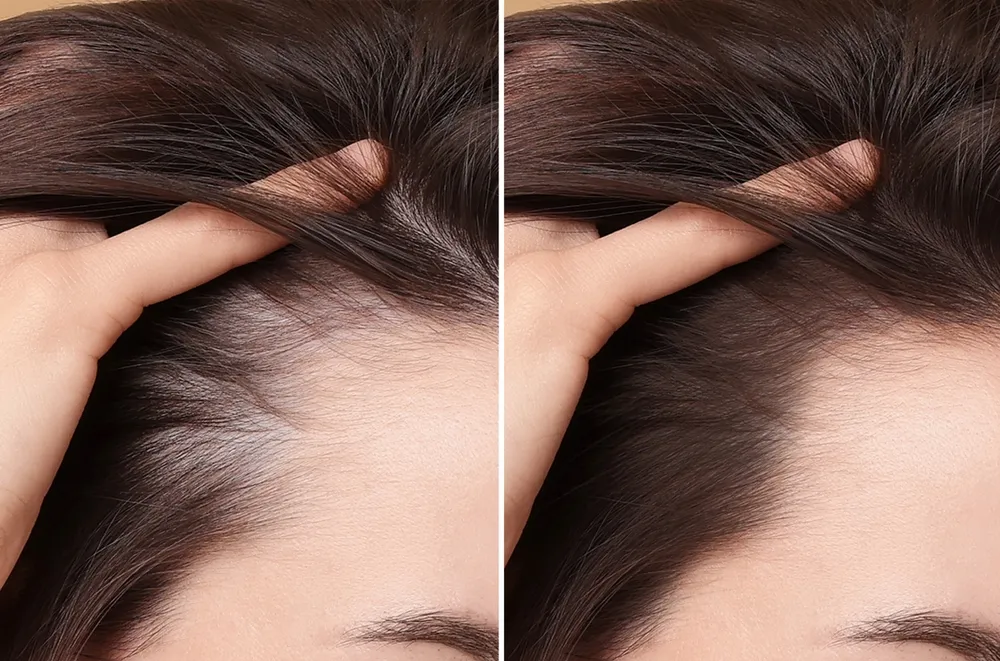
Female Hair Transplantation: Precision Reshaping Without Incisions
For women with tight scalps, irregular widow’s peaks, or mild temporal thinning, hair transplantation offers a non-surgical alternative:
Soft, Natural Hairline Micro-Design: Female hair transplants require specialized artistic design. Unlike male hairlines, which are often straight and sharp, female hairlines feature soft, oval, or heart-shaped curves with fine single-hair micro-grafts placed along the front edge to mimic natural growth.
No Linear Scarring: FUE and DHI methods leave no linear scars along the forehead. Grafts are harvested individually from the back of the head, leaving microscopic extraction dots that are easily hidden beneath surrounding long hair.
No Hair Shaving Required (Unshaven DHI): Modern female hair transplants in Turkey frequently utilize Unshaven DHI (Direct Hair Implantation). Surgeons harvest and implant grafts between existing hair strands without shaving the front of your head, allowing complete privacy during recovery.
Combining Both Options: The Ultimate Hybrid Solution
In many complex clinical cases, top facial plastic surgeons and hair restoration experts in Turkey recommend a combined approach:
Large Advancement + Scar Refinement: If a patient requires a large reduction ($>2.5 \text{ cm}$) or wishes to soften temporal corners, the surgeon performs surgical forehead reduction first to bring the bulk of the scalp forward.
Grafting Into the Surgical Scar: 6 to 9 months later, a small DHI hair transplant session ($800–1,500 \text{ grafts}$) can be performed directly into and around the mature surgical scar. This provides maximum coverage, hides incision lines, and rounds out temple curves for an exceptionally soft, natural finish.
Tabular Comparison: Treatment Costs in UK/Europe/USA vs. All-Inclusive Packages in Turkey
International patients benefit from world-class surgical expertise and transparent package pricing when choosing accredited clinics in Turkey:
| Evaluation Feature | Private Clinics in UK / EU / USA | All-Inclusive Packages in Turkey |
| Surgical Forehead Reduction | High ($7,000 – $14,000+); high facility fees. | Highly competitive ($2,500 – $4,200) complete package rate. |
| Female Hair Transplant (DHI) | $5,000 – $10,000+ charged per graft. | $1,800 – $3,200 for full session with top-tier tools. |
| Combined Surgery + Grafting | $12,000 – $22,000+ combined fees. | Integrated multi-phase package options at clear savings. |
| Travel & Logistics | Patient pays for local transit and hotels independently. | Includes 5-star hotel, VIP private airport transfers & translator. |
Recovery Protocols and What to Expect
Understanding the post-operative journey ensures smooth healing and peace of mind:
Recovery from Forehead Reduction Surgery: Patients wear a protective head wrap for 24 to 48 hours to minimize frontal swelling. Mild tightness across the scalp is common for the first 3 to 5 days. Fine hairline sutures are removed at day 7 to 10. Most patients return to desk work within 7 to 10 days. Full scar maturation occurs over 12 months.
Recovery from Female Hair Transplant: Recovery is rapid, with minimal discomfort. Tiny scabs around recipient grafts shed naturally within 10 to 12 days. Transplanted hair undergoes a temporary “shock loss” phase at weeks 3 to 6, with new permanent hair sprouting at month 3 to 4 and reaching full density at 12 months.
Frequently Asked Questions (FAQ)
1. How do I know if my scalp has enough elasticity for forehead reduction surgery?
You can test scalp laxity by placing your hands firmly on top of your scalp and pushing forward toward your forehead. If your scalp moves easily forward by 1.5 to 2.5 cm, you are likely a good candidate for surgical reduction. A surgeon will measure exact scalp mobility during your consultation.
2. Will forehead reduction surgery leave a noticeable scar?
When performed by an experienced facial plastic surgeon using a trichophytic incision, the scar is placed along the natural hairline and angled so hair follicles grow directly through it. The scar appears pink initially but fades into a fine, barely noticeable line within 6 to 12 months.
3. How long do I need to stay in Turkey for hairline lowering surgery?
For surgical forehead reduction, a stay of 6 to 8 days in Turkey is recommended. This allows time for pre-operative consultations, the surgical procedure, hospital rest, follow-up wound checks, and suture removal before flying home. For a hair transplant alone, a 3 to 4 day stay is sufficient.
4. Can forehead reduction surgery be combined with a brow lift?
Yes! Many women combine hairline lowering surgery with an endoscopic or surgical brow lift. Because the incision is placed along the hairline, surgeons can lift sagging eyebrows and smooth upper forehead furrows through the same access point.
5. Will female hair transplantation look natural along the front edge?
Yes. Skilled hair transplant specialists select fine single-hair grafts (rather than multi-hair units) for the frontal hairline, feathering them in a subtle zigzag pattern to replicate natural female hairline softness.
6. How do I start planning my hairline lowering journey in Turkey?
Getting started is simple. Take clear, high-resolution photographs of your hairline and forehead from the front, side, and 45-degree angles, and send them to an accredited clinic in Turkey. A specialized surgical team will perform a free remote assessment to advise whether surgery, a transplant, or a combination approach is best for your anatomy.

Hairline Lowering in Turkey: Forehead Reduction Surgery or Hair Transplant?
If you feel your forehead looks too high, hairline lowering in Turkey can help create more balanced facial proportions. Two options are forehead reduction surgery, which moves the hairline forward, and hair transplantation, which adds hair follicles to the desired area.
Forehead reduction may offer a more immediate change but requires sufficient scalp flexibility and leaves a surgical scar. A hair transplant offers gradual results and may suit people who want a more customised hairline, although the final density depends on donor hair and individual healing.
The most suitable approach depends on your hair characteristics, scalp condition, forehead proportions and expectations. A specialist assessment is essential before choosing either procedure.
Explore aesthetic treatments in Turkey with Cayra Clinic and learn more about hair transplantation.
Ready to explore your options? Contact Cayra Clinic to discuss your goals and receive personalised guidance.
