
As we age, the battle against gravity inevitably manifests in the lower third of the face. One of the most common and frustrating signs of facial aging is the appearance of jowls—the softening and sagging of skin and soft tissue along the jawline that disrupts a once-crisp, defined profile. When individuals begin searching for a solution, they are immediately met with an overwhelming array of choices, ranging from quick non-invasive lunchtime procedures to advanced surgical interventions.
Navigating options like thread lifts, mini facelifts, dermal fillers, and neck lifts can be confusing. Which treatment offers a temporary fix, and which provides a lasting structural reset? As international medical tourism continues to flourish—with Turkey renowned globally for its elite plastic surgeons and state-of-the-art accredited facilities—patients have unprecedented access to both non-surgical clinics and premier surgical centers. Let’s analyze each option in depth to discover what truly works for jowls.
Understanding Jowls: Why Do They Form and Where Do They Start?
To effectively treat jowls, we must first understand their root anatomical cause. Jowls are not merely caused by loose skin; they are the result of cumulative structural changes beneath the surface:
Fat Redistribution & Volume Loss: In youth, facial fat pads sit high on the cheekbones. With age, these fat pads deflate and descend due to gravity and diminished collagen production.
Ligament Laxity & Muscle Weakness: The retaining ligaments that anchor facial skin to the bone weaken over time. Simultaneously, the platysma muscle in the neck and lower face loses tone, allowing soft tissues to pool along the jawline.
Skin Thinning: A drop in elastin and collagen reduces skin recoil, making it unable to snap back into place.
Because jowls involve deep structural descent, surface-level treatments often yield vastly different results compared to surgical repositioning.
Dermal Fillers: The Art of Camouflage (Not a True Lift)
Dermal fillers (such as hyaluronic acid gels) are among the most popular non-surgical treatments worldwide, but their role in treating jowls is frequently misunderstood:
How They Work: Fillers do not lift sagging skin. Instead, skilled injectors use strategic structural placement—often in the cheeks, zygomatic arches, and pre-jowl sulcus (the hollow space just in front of the jowl)—to restore lost mid-face volume and optically camouflage the jowl shadow.
Pros and Cons: Fillers offer zero downtime and instant gratification. However, they provide only temporary results (9 to 18 months) and have distinct physical limits. Overfilling the lower face to “push” skin back can create a heavy, distorted, or pillow-like appearance rather than a sleek jawline.

Thread Lifts: The Minimal-Invasive Suspension Promise
Thread lifts gained massive popularity as a “lunchtime facelift,” promising immediate mechanical elevation using dissolvable medical-grade threads equipped with tiny barbs or cones:
How They Work: The practitioner inserts barbed threads beneath the skin via fine needles, catching and pulling sagging tissue upward toward the hairline or temples. Beyond mechanical lift, the threads stimulate localized collagen synthesis as they slowly dissolve over 6 to 9 months.
Pros and Cons: Thread lifts involve minimal downtime and no surgical incisions. However, their lift is strictly mechanical and temporary. They are only suitable for patients with very mild skin laxity and minimal jowling. For heavier tissue or profound sagging, threads can snap, slip, or fail to provide a meaningful, long-lasting contour.
Tabular Comparison: Jowl Treatment Options at a Glance
To clearly evaluate how non-surgical options compare against surgical gold standards, review the structured comparison table below:
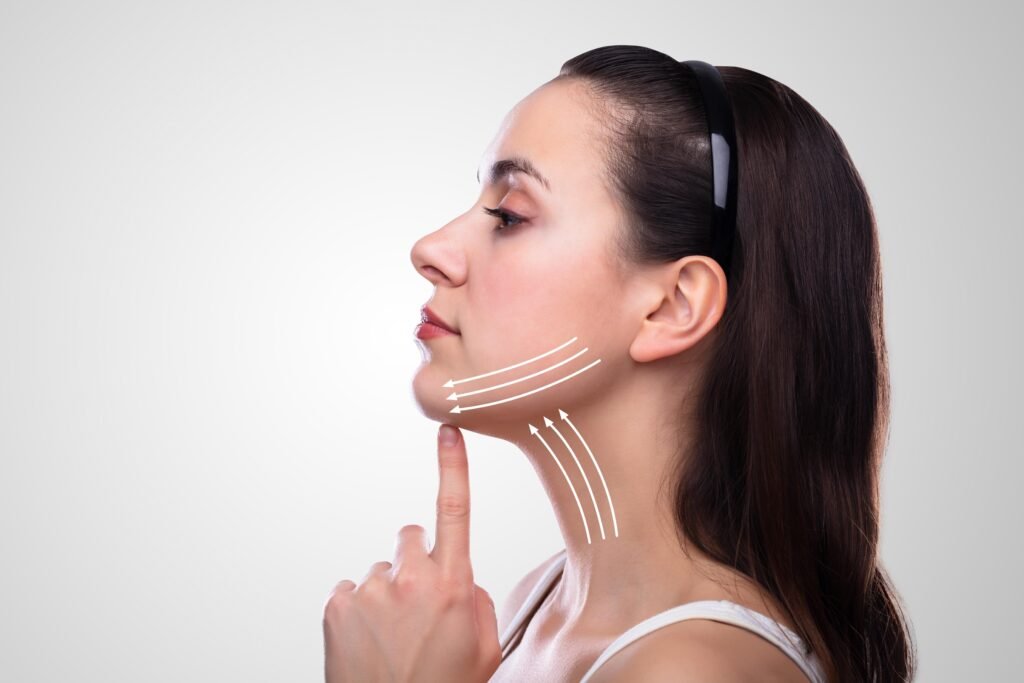
The Mini Facelift: The Surgical Gold Standard for Moderate Jowls
When non-surgical fillers and threads can no longer deliver satisfying transformations, the mini facelift steps in as the definitive surgical solution for jowls:
How It Works: Rather than pulling superficially on the skin, a mini facelift accesses the Superficial Musculoaponeurotic System (SMAS) layer through discrete incisions hidden around the ears. The surgeon lifts, tightens, and secures these deeper structural tissues back into their youthful vectors, trimming away redundant skin.
Why It Excels Against Jowls: By targeting the exact anatomical layer responsible for facial descent, a mini facelift erases jowls completely, recreates a sharp, chiseled jawline, and offers graceful, natural-looking results that outlast any temporary aesthetic treatment.
The Neck Lift Companion: Why Treating the Neck is Essential
Jowls rarely exist in isolation; they are almost universally accompanied by laxity, banding, or excess fat accumulation in the upper neck:
The Anatomy of Aging: If a patient undergoes a mini facelift to sharpen the jawline but ignores a sagging neck (turkey neck), the contrast creates an unnatural aesthetic mismatch.
Comprehensive Harmony: Combining a mini facelift with a neck lift allows the surgeon to tighten the platysma muscle, remove submental fat via micro-liposuction, and eliminate vertical neck bands. This creates a seamless, elegant transition from the chin down to the collarbone. As highlighted by top-tier surgical centers in Turkey, addressing both zones simultaneously yields the most harmonious, balanced rejuvenation.
Making Your Choice: Why Patients Choose Expert Care in Turkey
Deciding between a quick non-surgical fix and a permanent surgical solution depends entirely on your anatomical degree of aging, your lifestyle, and your long-term expectations. While fillers and thread lifts work well for minor touch-ups in younger patients, they can quickly become an expensive cycle of repeated treatments that ultimately fail to correct true tissue sagging.
For patients seeking definitive, life-changing results, Turkey has emerged as the global destination of choice. Offering world-class board-certified plastic surgeons specializing in deep-plane and mini facelifts, JCI-accredited hospitals, and transparent all-inclusive packages (incorporating luxury hotels and VIP transfers), patients receive elite surgical expertise at a fraction of Western costs.
Domande Frequenti (FAQ) / Frequently Asked Questions
1. Can dermal fillers completely get rid of my jowls?
No. Dermal fillers can only camouflage minor jowls by restoring volume to the surrounding cheeks and pre-jowl sulcus. If you have true skin laxity and heavy tissue hanging below the jawline, fillers will make the lower face look heavy rather than lifted.
2. How long does a mini facelift last compared to a thread lift?
A mini facelift provides structural, long-lasting results that typically endure for 5 to 10 years or more. In contrast, a thread lift is a temporary procedure whose effects usually wear off within 12 to 18 months as the threads dissolve.
3. Will I need a full facelift if I have jowls, or is a mini facelift enough?
If your primary aging concerns are localized to the lower face, jawline, and mild neck laxity, a mini facelift is usually more than sufficient. A full facelift is typically reserved for patients with advanced mid-face sagging, deep wrinkles, and severe skin excess across the entire face.
4. Is a neck lift always performed alongside a mini facelift?
Not always, but it is frequently combined because the jawline and neck age together. If you have significant loose skin or muscle banding beneath the chin, adding a neck lift ensures your final profile looks completely balanced and natural.
5. What is the recovery time for a mini facelift versus non-surgical options?
Non-surgical options like fillers and thread lifts have virtually zero downtime, allowing you to resume normal activities immediately. A mini facelift requires a social downtime of about 7 to 10 days before initial swelling subsides and sutures are removed.
6. Why is Turkey so popular for surgical jowl treatments?
Turkey combines elite surgical talent, cutting-edge hospital infrastructure, and exceptional value. Comprehensive all-inclusive packages cover everything from surgery and hospital stays to 5-star hotel recovery and VIP transport, making top-tier care accessible.
Thread Lift vs Mini Facelift: Which Treatment Works Best for Jowls?
Sagging skin around the jawline can make the face appear older, but several treatments may help improve facial contours. Thread lifts, mini facelifts, dermal fillers and neck lifts work in different ways, and the most suitable option depends on skin laxity, facial volume loss and your desired results.
A thread lift may provide a temporary lifting effect, while a mini facelift can address certain signs of sagging more directly. Fillers may restore lost volume, whereas a neck lift targets loose skin and tissues around the neck. Learn more from the American Society of Plastic Surgeons and consult a qualified specialist to understand the benefits, limitations and risks of each option.
At Cayra Clinic, you can explore aesthetic treatments in Turkey and receive information about options suited to your individual needs. You can also discover our services for hair transplantation and dental treatments.
Ready to improve your jawline and facial contours? Contact Cayra Clinic to learn more about facial rejuvenation options and discuss a personalised treatment plan.
