
Occipital bone reduction surgery in Turkey at Cayra Clinic offers a permanent, safe solution for patients who feel self-conscious about a prominent or protruding back of the skull. With specialist craniofacial surgeons in both Istanbul and Antalya, Cayra Clinic delivers exceptional results at a fraction of the cost of the UK or Western Europe — without compromising on safety, technology, or aftercare.
Occipital bone reduction — also known as occipital knob removal or posterior skull reduction — is a surgical procedure that reshapes the back of the skull to create a smoother, flatter and more aesthetically balanced profile. The occipital bone is the bone that forms the lower-back portion of the skull. In some patients, this bone develops an abnormal protrusion — commonly called an occipital knob or occipital bossing — that creates a visible bump at the back of the head.
This condition is most noticeable in patients who keep their hair short or shaved, and can cause significant self-consciousness. The surgery removes this excess outer bone tissue to create a natural, balanced contour.
The occipital protrusion develops due to an abnormal thickening of the outer cortical layer of the occipital bone along the nuchal line. In the majority of cases it is a benign anatomical variation — not a medical condition — but its impact on the patient’s confidence and quality of life can be significant. It is more common in men and is often first noticed when hair is cut very short or the head is shaved.
You may be an ideal candidate for occipital bone reduction surgery in Turkey if:
— You have a visible, prominent bump or protrusion at the back of your skull.
— The prominence is causing you self-consciousness, particularly with short or shaved hair.
— You are in good general health with no active systemic conditions.
— You have realistic expectations about the degree of improvement achievable.
— You are a non-smoker, or willing to stop smoking for the required period before and after surgery.
— You have not had previous surgery in the occipital region.
Patients with very thin outer cortical bone (identified on CT scan), active scalp infections, blood coagulation disorders, or uncontrolled systemic conditions such as unmanaged diabetes may not be suitable candidates. At Cayra Clinic, every patient undergoes a thorough pre-operative assessment — including 3D CT imaging — to confirm suitability before any procedure is planned.
Before your procedure, you will receive a detailed consultation with your surgeon. This includes a review of your medical history, a physical examination of the occipital region, and a 3D CT scan to precisely map the bone thickness and determine the safe and achievable degree of reduction. No patient at Cayra Clinic proceeds to surgery without this imaging assessment.
Occipital bone reduction surgery is performed under general anaesthesia and typically takes between 1.5 and 2.5 hours depending on the size of the protrusion and the complexity of the reshaping required.
The surgeon makes a small horizontal incision, typically no longer than 3 to 4 centimetres, directly over the occipital prominence, positioned so that it is hidden within the hairline. The outer cortical layer of bone is then carefully reduced using a high-speed surgical burring tool, contouring the area until it is smooth and flush with the surrounding skull. Only the outer table of the skull is removed, the inner bone layers that protect the brain are not touched, making this a safe and well-established procedure.
The incision is then closed in layers with dissolvable sutures internally and fine sutures at skin level.
Most patients are discharged 1 to 2 days after surgery. An overnight stay at the clinic is standard to allow for monitoring in the immediate post-operative period.
Understanding the recovery timeline is an important part of planning your procedure.
Days 1–3: Some swelling, tightness and mild discomfort at the back of the head is normal. Prescription pain relief is provided. Patients are advised to sleep with the head slightly elevated.
Days 4–10: Swelling begins to reduce. Most patients feel comfortable moving around and can manage daily activities. The incision area should be kept dry and clean as per your surgeon’s instructions. Sutures are typically removed at around 10 days.
Weeks 2–4: The majority of visible swelling resolves. Patients can return to sedentary work and light activity. Strenuous exercise and heavy lifting should be avoided.
Months 2–3: The final result becomes clearly visible as all residual swelling resolves and the scalp softens over the reshaped bone.
Flying home: Most international patients from the UK and Europe fly home 5 to 7 days after surgery. Cayra Clinic’s patient coordination team manages all logistics and ensures you have complete written post-operative instructions before departure.
In the UK and Western Europe, occipital bone reduction surgery is rarely available on the NHS and privately costs between £10,000 and £20,000 depending on the surgeon, facility and complexity of the procedure. In Turkey, the same procedure — performed by an equally qualified craniofacial surgeon in a fully equipped modern facility — is available from £6,000 to £9,000 all-inclusive, representing a saving of up to 60% without any compromise on surgical standards or aftercare quality.
At Cayra Clinic, our all-inclusive packages for occipital bone reduction surgery in Istanbul and Antalya include:
— Pre-operative 3D CT scan and surgeon consultation — General anaesthesia and operating theatre fees — Overnight hospital stay (1–2 nights as required) — All post-operative medications and wound care kit — Airport and hotel transfers — English-speaking patient coordinator throughout — 12-month post-operative follow-up support
Contact us for a personalised quote based on your CT imaging and specific surgical requirements. We do not provide prices before a medical assessment, because we believe your safety and your result are more important than a quick number.
Occipital bone reduction requires a surgeon with specific expertise in cranial reshaping — not simply a general plastic surgeon. At Cayra Clinic, the procedure is performed exclusively by surgeons with dedicated craniofacial and cranial contouring experience, with a volume of cases that is not achievable in most UK or European centres.
Cayra Clinic operates from two locations in Turkey: Istanbul, one of Europe’s most connected medical tourism destinations, and Antalya, a city increasingly recognised for its high standard of private healthcare and direct flight connections from across the UK and Europe. Both facilities are fully equipped for cranial procedures and follow identical clinical protocols.
Every occipital bone reduction at Cayra Clinic is planned using 3D CT imaging. This allows the surgeon to measure the exact thickness of the outer cortical bone, determine the maximum safe reduction, and plan the precise contour before a single incision is made. This is not standard practice at all clinics — at Cayra Clinic it is non-negotiable.
There are no hidden costs. Everything from your CT scan to your airport transfer is included in your package. Your patient coordinator speaks English and is available throughout your journey — before you travel, during your stay in Turkey, and after you return home.
Cayra Clinic has extensive experience treating patients travelling from the UK, Ireland, Germany, the Netherlands, Scandinavia and beyond. We understand the specific concerns of international patients — including travel logistics, post-operative flying, and long-distance follow-up — and our protocols are designed around those needs.
According to the International Society of Aesthetic Plastic Surgery (ISAPS), cranial contouring procedures performed by board-certified craniofacial surgeons carry a very low complication rate when patients are properly selected and pre-operative imaging is used. The British Association of Plastic, Reconstructive and Aesthetic Surgeons (BAPRAS) also recommends thorough pre-operative CT assessment for all skull reshaping procedures.
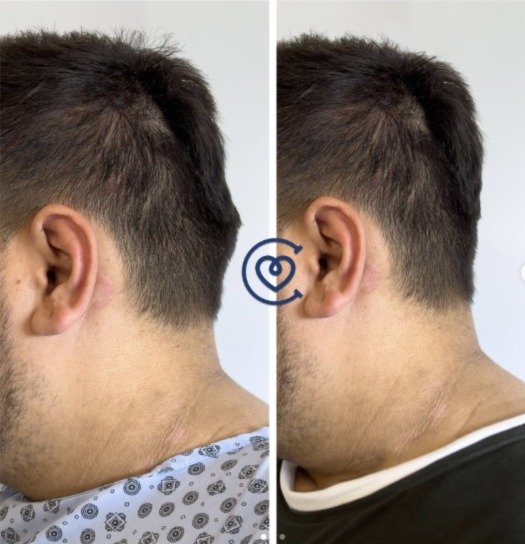
See real occipital bone reduction results from Cayra Clinic patients. Our before & after gallery includes verified patient cases with full recovery documentation.
— Patient Before & After — Case 1
— Patient Before & After — Case 2
Results shown are from real Cayra Clinic patients. Individual results may vary.
Yes. Occipital bone reduction is a well-established procedure when performed by an experienced craniofacial surgeon. The surgery only removes the outer cortical table of the skull — the inner bone layers that protect the brain are not affected. As with any surgical procedure, risks exist, and these will be discussed in full during your consultation.
The incision is small — typically 3 to 4 centimetres — and is positioned along a natural skin crease at the back of the head, within the hairline. In patients with even short hair, the scar is typically not visible. Most patients report the scar fades significantly within 6 to 12 months.
This depends entirely on the individual anatomy of your skull, specifically the thickness of the outer cortical layer. The 3D CT scan performed before surgery gives your surgeon precise measurements. Some patients can achieve reductions of 8–12mm or more; others with thinner bone may achieve less. Your surgeon will give you a realistic assessment based on your imaging.
We recommend a minimum stay of 5 to 7 days in Turkey. This allows for your pre-operative appointment, the surgery itself, one to two nights of post-operative monitoring, and a final check before you fly home.
Yes. Many patients combine occipital bone reduction with other skull or facial contouring procedures. This is assessed on a case-by-case basis during your consultation. Combining procedures in a single surgical session can be more efficient for international patients and will be discussed if appropriate for your specific goals.
An occipital knob is a specific, localised protrusion along the nuchal line — typically a small but very prominent bump. Full occipital reduction addresses broader flattening of the posterior skull profile. Both are performed using similar techniques; the scope depends on your anatomy and your goals.
If you are considering occipital bone reduction surgery in Turkey, the first step is a free, no-obligation medical assessment with the Cayra Clinic team. Send us photos of the occipital region from multiple angles and we will provide a preliminary assessment from our surgical team — before any commitment is required.
We treat every enquiry with complete medical confidentiality and without any sales pressure. Our goal is to give you honest, accurate information so you can make the right decision for yourself.
Request Your Free Assessment — Cayra Clinic Istanbul & Antalya
Learn about our clavicle reduction surgery, jaw surgery, and our full range of facial contouring procedures.